In which there’s no recipe BECAUSE BREAD IS ENTIRELY fucking RANDOM! Whoo! IT’S ALIVE!
This is one of those food blog posts in which the author bangs on and on about nothing and talks about her personal life, but there’s no recipe at the end so it’s technically not one of those posts, you know, the ones I bitch about because the irrelevant nonsense takes like half an hour to scroll past before you get to the fucking recipe but there is no recipe here so it’s totally different!
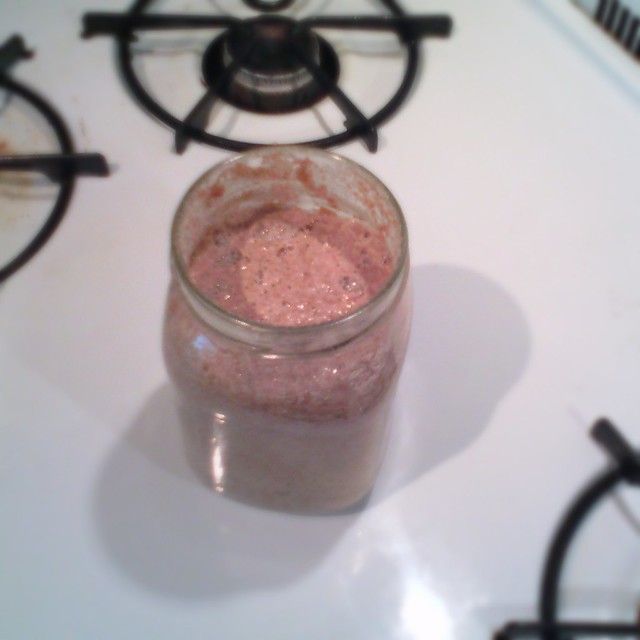
I have no idea if any of this about the healthfulness or digestibility of sourdough bread is scientifically backed or even true, but it sounds nice and I’ve had time on my hands so I grew some sourdough starter and fed it every day for about a week.
Then I split it in half, and now I have two sourdough starters: one primarily white, one whole wheat. (The whole wheat one is slightly more active, which is the opposite of what I expected.)
I know nothing about baking but I can cook, I can read, and I can learn. So I’ve been reading everything I can get my eyeballs on about traditional bread baking, no-knead bread, and sourdough.
My observation is that there’s no such thing as a bread recipe. Every single recipe is different. Every single video shows utterly different methods. Baking temperature, baking times are always wildly divergent, even for the same amount of the same type of dough. It’s a complete disaster, this whole bread-baking thing.
If you want, for example, to learn how to make enchilada sauce, because you’re not Mexican and you never saw the elder women in your family do it and so you have very little sense of how it’s done, you get online and you read anywhere from 6 to thirty enchilada sauce recipes in a row. You find out what all the recipes have in common in terms of ingredients, ratios, and procedures, and you more or less do the mean, the average, the gist of all those recipes. And you’re going to end up with something fantastic.
This is how I have learned make everything I cook, from chicken noodle soup to pudlas: read as many recipes as possible, do what they all have in common. If you see the same exact noodle recipe in fifteen different places, use that one. It’s the one that works.
People have been baking bread for ten thousand years, and apparently everybody does it differently and has a different pet theory about what’s happening in the proofing bowl. Bread’s alive, and it responds to the various environments it finds itself in, so there are no hard and fast rules. All those incredibly verbose bread blogs I skimmed are trying to teach instinct, not technique: how to tell when to add more flour, when to leave it alone, when to bake it and for how long and how high. Every single blog says somewhere that you just have to bake enough bread to get a feel for it.
My conclusion: It’s just fucking bread! We discovered leavening by accident, probably from just leaving dough lying around like lazy ancient hippies! There is no technique as much as intuition! Apparently any idiot can make bread!
And I’m definitely any idiot. (In my entire life I’d made no-knead bread twice, a couple of soda breads that don’t even count, and a kneaded sourdough once that didn’t really turn out that well because I dunno shit about kneading bread. And that’s my whole entire baking career.) So I decided to wing it and go by feels!
I’d gotten the starters down from the top of the fridge to feed them and thought, “What the hell. I’ll use the discards and fake my way through some bread.” So I poured half of each into the ugly pink bowl that is my only bowl and therefore gets constant use — possibly as much as two cups of unfed starter, maybe even more — added some warm tap water, added some white flour, added some salt, added some yeast. Stirred it up. Set the bowl on the top of the (gas, and therefore always warm) stove and covered it. And forgot about it for twelve hours while I drank wine, read sci-fi, watched 70’s British horror films, and slept.
Sometime in the middle of the next day I poured the doubled-in-volume, bubbly dough out onto a floured counter top and it was so wet it just ran all over the place. I had to scrape it up with a spatula. It was a huge, sticky fucking mess. I threw it back into the bowl with a bunch of flour and stirred it up, then covered it and returned it to the top of the stove.
Did the same thing again in the evening. The dough was slightly stiffer, but still just flopped all over the place and could scarcely be folded in thirds. Needless to say, I floured the hell out of it and stuck it back in its bowl — after I’d scraped a bunch of half-dried sticky wallpaper paste out of it and washed and dried it — on top of a generous sheet of parchment.
At about the 24-hour mark, I used the now-damp parchment paper to lift it — still a floppy mass and unable to hold a shape, but still clearly active in terms of yeast — into a pre-heated stainless steel stockpot in a 400F oven, where I let it bake for the better part of an hour, misting the floor of the oven with water at random intervals and watching classic pro-wrestling with my boyfriend. (Some of those costumes are seriously hilarious, as is this video. Plus he gets a kick out of it, so who am I to judge.)

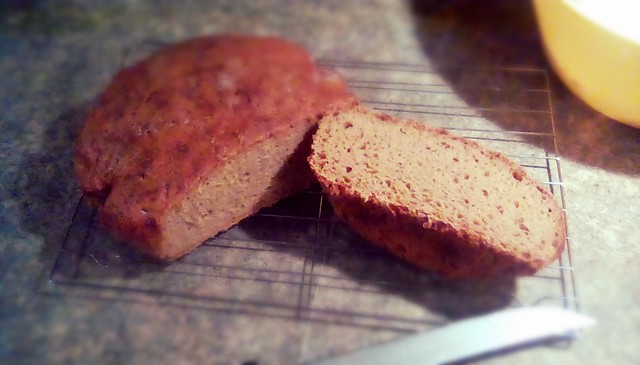
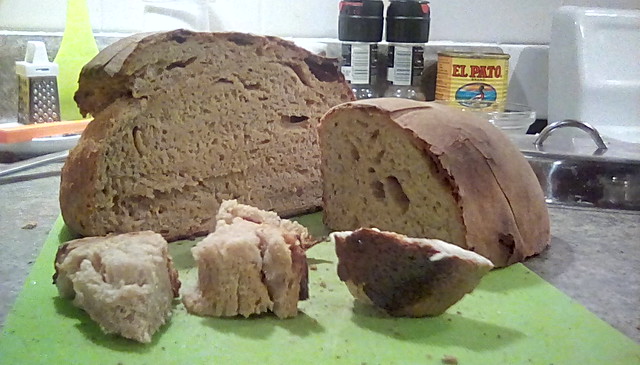
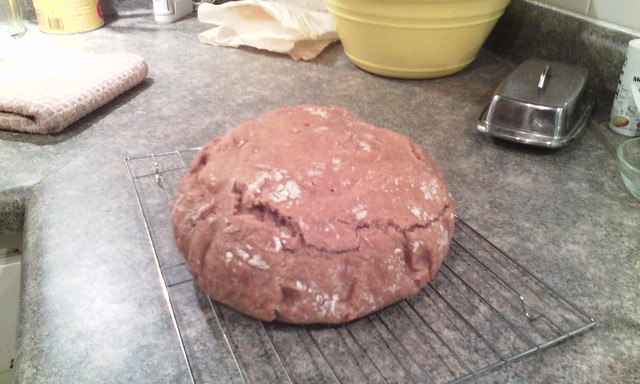
When knocking on the bottom of the loaf produced a hollow sound we left off baking (even though I’m convinced it could easily have stood another 15 minutes in the oven). It overnighted on a wire rack, and when I got up today I cut into it. It’s heavy, moist, with what they call ‘beautiful artisanal crumb’ and a gorgeous (for a bread containing whole wheat) soft but chewy crust.
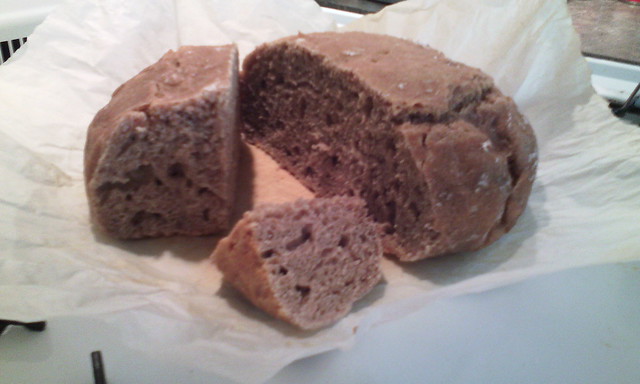
It’s also incredibly sour, like a San Francisco loaf. So sour it drowns out the taste of butter altogether. I knew it would be sour because of the long rise time, but it’s REALLY SOUR. It’ll have to be eaten with really strong flavors: olive tapenade, aged cheeses, pesto. Maybe a thick, spicy tomato soup.
I’m guessing that the whole kneading thing offers a baker a little more control over her bread, but I’m not sure I’m up to bothering to learn it yet when I can have perfectly edible loaves with the no-knead “method” and time and guesses.
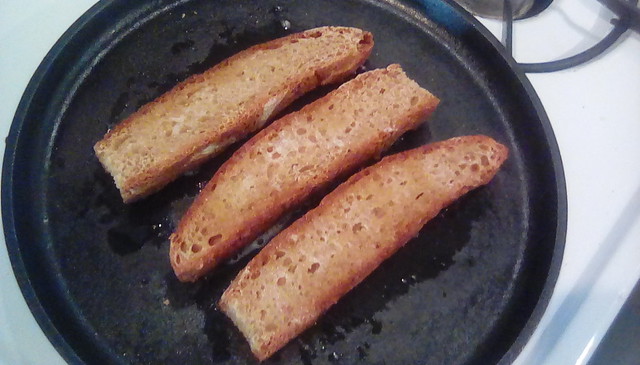
Off to go see what the internet suggests one do with a very sour loaf of sourdough bread, then.